still life nr1

still life nr1

Tuesday, 8 November 2011

predominantly shape, form and colour

I got my tutor report and feedback on assignment 4.  This time I have more things to work on so I will start from looking on suggested artists. Unfortunately I can use only secondary sources like images from the internet, as I do not have opportunity go to the galleries where they are on display.


Milton Avery 1885-1965

Three friends 1944


Seated figure


What strikes me that in his work is the way how Milton operates with colour and big bold shapes.  He feels the space with only few colours but extremely well chosen.  Deformed bodies of his models make his paintings more interesting.  Many times his models do not have their faces or hands do not have fingers.  Perspective looks like is wrong but it works well with deformation of model's bodies.  Paint is transparent on many of his paintings so that we can see a brush marks and sometimes a clean canvas.

In my next project, I will try to play with bold big shapes and single colours like Milton did.


Mali Morris is my next artist.


flotilla 2007

http://www.royalacademy.org.uk/academicians/painters/mali-morris-ra,1227,AR.html


Mali Morris is an abstract artist who expresses her art thought the vibrant colours and quick movement of brush or any tool that she uses.  Morris' art looks untidy but when I spend more time looking at her work I become more familiar with this style.  I am starting to like it and finding something peculiar and interesting.

It works well as a composition and many times it is a geometrically order.  Some times the painting is crowded but sometimes it is spacious.  Mali uses large individual units to cover the space. The lines are sometimes curved and sometimes angular.  A big contrast has been created by using different colours; the dark background will meet the light colours.


http://www.malimorris.co.uk/

In my next few projects I will definitely use her expressive line with contrastive colours


Helen Frankenthaler


http://www.ernst-haas.com/celebrity_frankenthalerHelen1.html

 There is a short movie about Helen on youtube and worth to watch :

http://www.youtube.com/watch?v=PsoaxUcwp3s


I am glad to say that I liked this artist from the first moment, her sensibility got to me straight.  I didn't have to think about it, I just knew I liked it
Helen's art reminds me some sort of Japanese art in how she operates with the line and colour.
Definitely, I will use this artist as my future inspiration.

CHAPTER 9: Expressionism


Well well , finally that gift from my brother in law from last Christmas, will find some useful meaning in my research.

(quoted from p. 15)
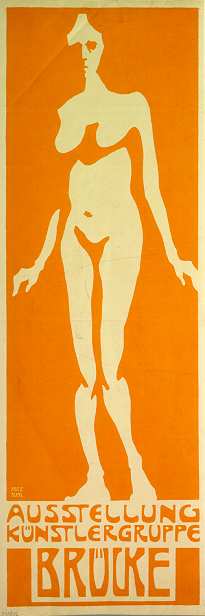
"The Brucke Group of Artists
 On 7 June 1905, four students of architecture at Dresden formed a group of artists called Die Brucke ( The Bridge). They were Fritz Bleyl, Ernst Ludwig Kirchner, Erich Heckel and  Karl Schmidt-Rottluff.
They were young artists aged between 21 and 25 who expressed conflict of artists from that generation.
In 1906, Kirchner had made a wood cut of the text - the stylized motif of a bridge: "We believe in development and in a generation of young people who are both creative and appreciative; we call together all young people, and- as young people who bear the future- we want to acquire freedom for our hands and lives, against the well-established older forces. Everyone belongs to us who renders in an immediate and unfalsified  way everything that compels him to be creative."
What was so special and characteristic for that movement?
  • deformation
  • very bright colours
  • spontaneity so close to primitive art
art was the only way to express emotion
 Fritz Bleyl 1880-1966 


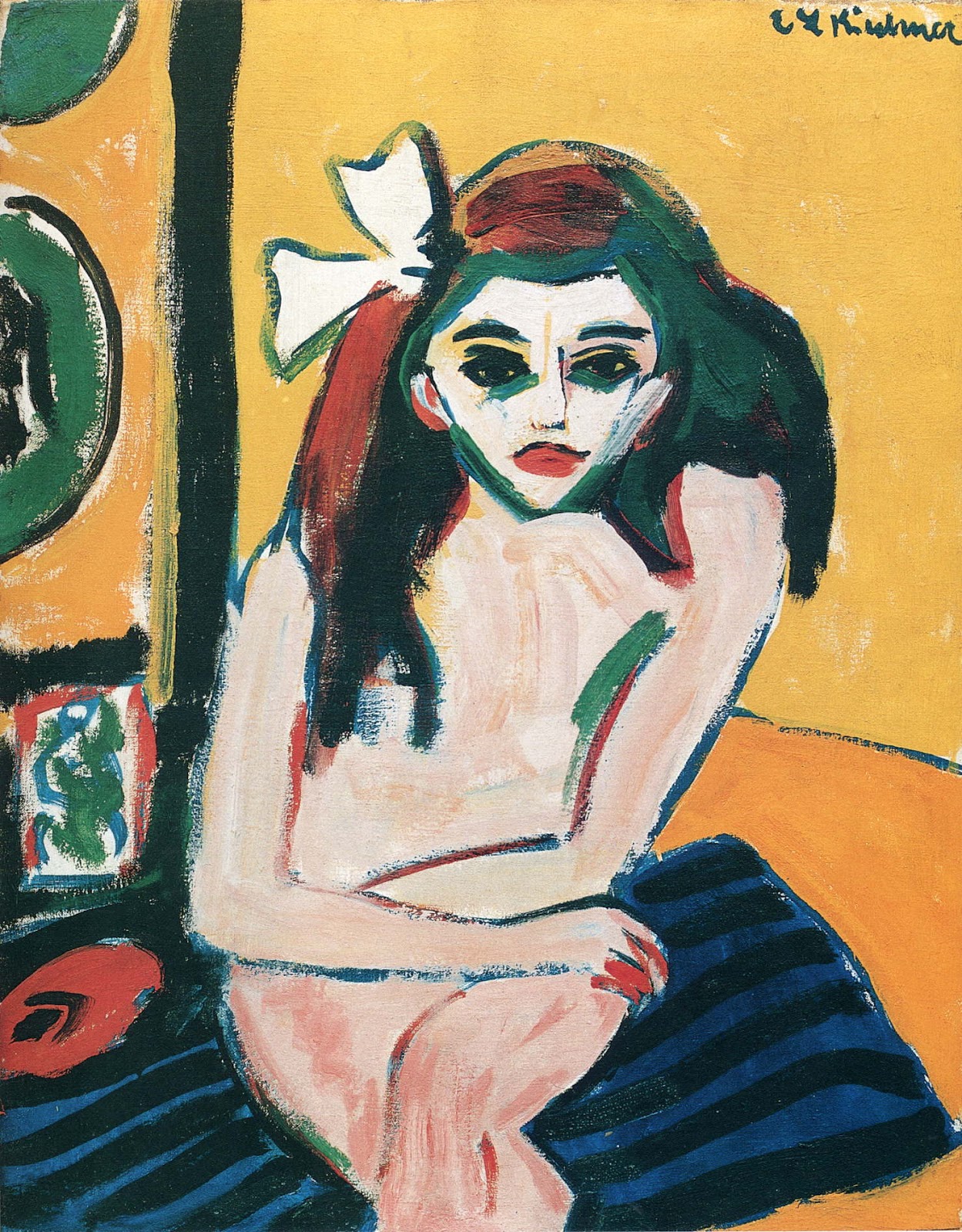
 Ernst Ludwig Kirchner 1880-1938

 File:Ernst Ludwig Kirchner Sitzende Dame (Dodo) 1907-1.jpg

 Sitting Woman, 1907                                               Marzella (1909–10)

Erich Heckel 1883-1970

 Erich Heckel painting at the easel


Red Huses 1908

Karl Schmidt-Rottluff 1883-1976

Duble Portrait S. and L. 1925

Dyke Breach 1910

The most famous names are Vincent van Gogh and Edvard Munch.

Edvard Munch 1863-1944

The scream 1893

The dance of life 1899-1900

Vincent van Gogh 1853-1890

Starry night


self-portrait 1889

In polish art the biggest and the most important artist was Stanislaw Ignacy Witkiewicz ( Witkacy). I was very lucky to have opportunity to see his paintings many times in my home town of Lodz in Poland. His work is display in Muzeum Sztuki which is the museum of modern polish art.
You may go on this address :

 http://msl.org.pl/en/sztuka/index/id,1787 

http://msl.org.pl/en/index

http://www.krakowpost.com/article/1181

Witkacy 1885-1939

Rabanie lasu.Walka 1921 -1922


Krytyka zza grobu

Stworzenie swiata

Sunday, 9 October 2011

CHAPTER 7 : Project 2

Project 2 : Developing a Shorthand

Stage 1 : Drawing Shapes
Stage 2 : Colour Notes and Numbered Tones
Stage 3 : Assessing Your Information

Unfortunately I haven't taken any scans of any of those stages so I have to start from Stage 4 which is a painting.

Stage 4 : Painting


This time I started from a very dark brown base then stage by stage I was adding some more bright colours.


Stage 5 : What have you Achieved?

This project  was different from the rest that I have done so far. Definitely I used my skills to describe the tones of the objects and making quick decisions about them. As you may see I started from the darkest parts and then adding some lighter and finishing with just light tones. The composition is open from the right side. I decided to stand on my bed to look from above to make the composition more interesting where the ironing board looks bit smaller and points on the right directions, but not on very straight line.
Colours are limited with a large amount of white paint.
I used acrylics for this task
 If I use this way of recording information about objects for future paintings, that will give me only simple clues and will live a lot of space for my imagination.

Saturday, 8 October 2011

drawings and famous paintings

Klimt, Drawing, Hermine Gallia Sitzende (Study for a Portrait of Hermine Gallia), c. 1903
 gustav klimt study to portrait of Hermine Gallia

 Portrait of Hermine Gallia
painting of Hermine Gallia


Seurat study for